Concepts
Three pillars of
meaningful
transformation.
David's work revolves around a proven framework that moves organizations from insight to implementation.
Visioning
Strategy Development
Working with strategic leaders to establish a clear, human-centered north star that aligns all stakeholders, defines success, and ensures transformation efforts are grounded in real user and business value.
Implementation
Project charter development
Translates vision into tangible, pragmatic systems and behaviors through iterative design, testing, and cross-functional execution.
Sustaining
Leading Leaders Through Change programs
Embedding change into culture, governance, and continuous learning loops so the organization can adapt, scale, and realize long-term impact rather than short-term gains.
Resources
Frameworks & Tools
Download these strategic frameworks to explore David's approach to transformation.
(Don't worry — we will not ask for your email or contact information)
Case Studies
Transformation in action.
Real-world engagements where design-led thinking delivered measurable outcomes.
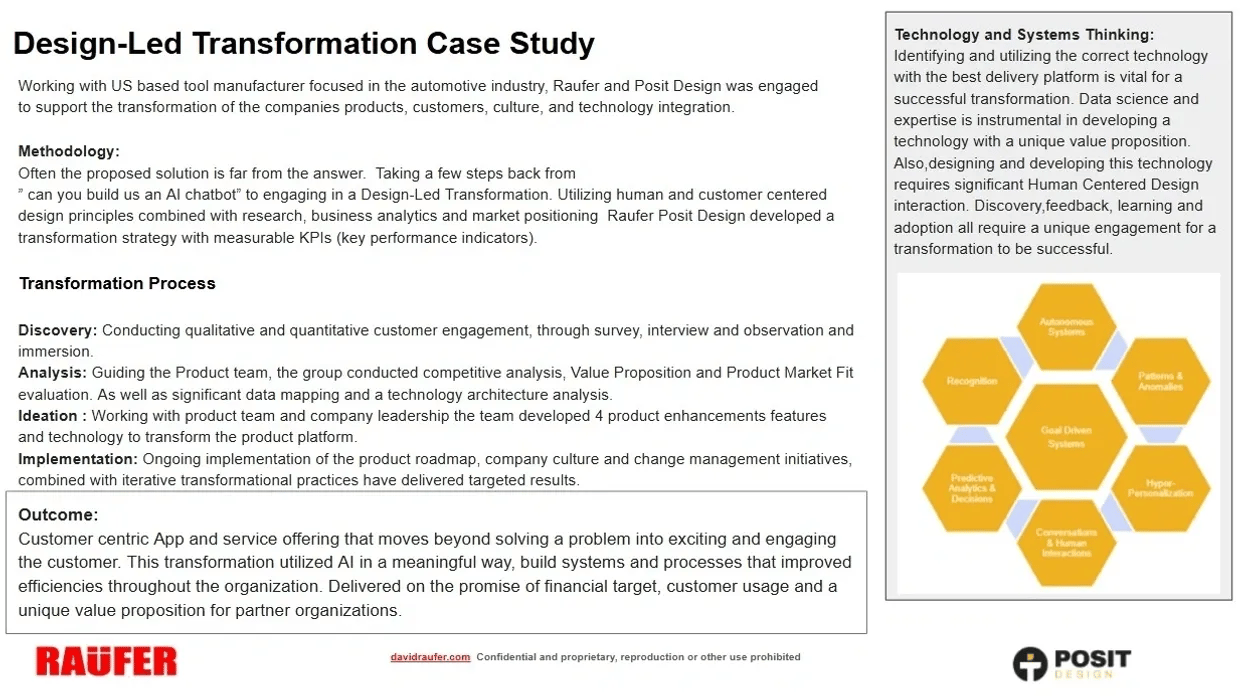
Design-Led Transformation
US-Based Tool Manufacturer — Automotive Industry
Partnering with a US-based tool manufacturer, Raufer and Posit Design engaged in a full Design-Led Transformation — leveraging human centered design, business analytics, and market positioning to deliver a customer-centric product platform with measurable KPIs.
Discovery
Qualitative and quantitative customer engagement through survey, interview, observation and immersion.
Analysis
Competitive analysis, Value Proposition and Product Market Fit evaluation, data mapping, and technology architecture analysis.
Ideation
Developed 4 product enhancement features and technology solutions to transform the product platform.
Implementation
Ongoing product roadmap execution, culture initiatives, and iterative change management delivering targeted results.
Outcome
A customer-centric app and service offering that moves beyond solving a problem into exciting and engaging the customer — utilizing AI meaningfully, building systems that improved efficiencies, and delivering on financial targets and partner value.
How might we use Human Centered Design to disrupt our understanding of death so that we might reimagine the end of life?
Challenge
Our culture avoids the conversation around death, leaving individuals and families unprepared for end-of-life decisions.
Approach
Using our common human experience of love and loss to inform, reflect, and share stories — creating a platform for open dialogue.
Impact
A transformation that changes how we prepare for end of life — for ourselves, our loved ones, the death industry, and our culture.
Outcome
This project utilizes Human Centered Design to create meaningful change in one of life's most universal experiences — discovery, feedback, learning, and adoption all require a unique engagement for a transformation to be successful.